By: Julian Kimble

It began as a joke that Monday. My godbrother and I were having a morning Gchat conversation about the brewing DeSean Jackson saga. Still baffled by why the Eagles would consider parting with one of the most electrifying players in the NFL, we jokingly surmised that it was because the organization suspected he was a Crip. Little did we know, the Eagles would silently hide behind that very claim as a shield for releasing Jackson in just a few days. That’s another joke, one I don’t find amusing in the least. I love being right, yet this was one of the few moments I actually wished I was wrong.
It’s been two weeks since the Eagles cut Jackson, and the move has left a taste in my mouth far worse than your breath after a night of drinking Hennessy or eating a pound of Buffalo wings. Not only was he the Eagles’ best receiver (on the current roster and since Terrell Owens’ mercurial season-and-a-half with the team), he was one of my favorite players in the league. I was overjoyed when the team drafted him in 2008 because it showed their recognition of a need for explosive talent at the wide receiver position to contend.
When rumors about the team’s willingness to part ways with Jackson (which were amplified by team brass’ refusal to dispel them when given the chance), I slowly began to prepare for his departure. What I didn’t prepare for, however, was his release in the wake of a NJ.com article connecting him to gang members. The Eagles had presumably failed at trying to deal Jackson, and probably knew the only way they’d be able to justify releasing a 27-year-old coming off a career season and his third Pro Bowl selection was to do it amidst allegations of his gang ties. This was a frustrating reminder that the NFL is still a business, and, at times, a shady one.
Never forget for one second that the NFL adheres to standard corporate practices, and the Eagles’ handling of DeSean Jackson felt like the typical corporate screw job. If the team decided they wanted to go in another direction, myself and fellow Eagles fans would simply have to swallow that jagged pill. Hell, they cut Brian Westbrook two seasons after he set a then-NFL record for all-purpose yards—the business is ugly like that sometimes. But getting rid of Jackson, then hiding behind rumors of gang connections (which the LAPD shot down) and unconfirmed, abrupt reports of him being a problem child in a post-Aaron Hernandez league is a cowardly low. He’s been in the league for six years and we’re just now finding out that he’s a petulant cancer? Come on.
It’s one thing to move on from someone, but to try and sully their reputation and fuck with their livelihood is a problem, especially when the claims against them are paper thin. Sadly, that’s the way it goes in the corporate world: when your employer decides they don’t want you anymore, they’ll cast you out in the cold and try to make it look like it’s your fault.
It bothers me that so many people point to the silence of Jackson’s now former teammates as proof that his character deserves questioning. Let’s use common sense for a second: if your job fires one of its most valuable employees, would you be eager to place a target on your back and speak out against your employer? The message that no one is safe has been sent. That’s why I applaud LeSean McCoy for supporting Jackson. “I don’t know how honest that would be,” he said of allegations of Jackson being problematic. “It is a surprise. You’ve heard so much, you don’t really know [what’s true].” Don’t believe all the talk of Jackson being a “distraction,” especially when the Eagles have dealt with worse.
I’ll be honest: what genuinely bothers me about this circus is that Jackson is gone, yet Riley Cooper is still an Eagle. Last summer, footage of Cooper saying “I’ll fight every nigger here, bro” while wearing the redneck uniform leaked. He was filmed delivering a racial slur in the midst of a threat and insulted not only his teammates, but other members of the organization. I’d implore him to stand up in the locker room and repeat that statement. It’s far more detrimental to the very delicate fabric of team and organizational structure than anything DeSean Jackson was accused of, but what did Cooper get? The chance to apologize while wearing a ponytail of remorse, a fine, a vacation from training camp, and, ultimately, a brand new contract. It’s a classic example of white privilege in action.
Richard Sherman said it best in an essay that needed to be written: “Commit certain crimes in this league and be a certain color, and you get help, not scorn.” Riley Cooper may not have broken a law, but he committed a social crime. Ben Roethlisberger was accused of sexual assault on more than one occasion, and though he was punished with a suspension (that was eventually reduced) by the NFL, his employer never dragged his name through the mud. He got “help.” Colts owner Jim Irsay got caught driving recklessly with pills and $29,000 in cash, and, like Sherman wrote, he’s viewed as a victim. Someone else who needs “help.” DeSean Jackson committed no crime, yet will continue to be treated like a criminal.
DeSean Jackson is guilty of two things, with the first being occasional bouts of immaturity. The All-American Bowl fumble, the goal line fumble from his rookie year and the sporadic unnecessary Instagram post are evidence. But what he’s really guilty of is being young, black and successful. As a black man, much of your success hinges on how comfortable white America is with you. Like I was told time and time again at my first job, perception is reality, which means you’re guilty until proven innocent; guilty if people are afraid of you. Hell, people are still mad at Mike Vick, even after he did 18 months in federal prison and lost everything. It’s easy for some to believe DeSean Jackson is a threat, menace or villain because of speculation, his jawing with opposing defensive backs and pre and post-touchdown celebrations. The fact that he’s a black man named DeSean Jackson from Los Angeles makes it even easier.
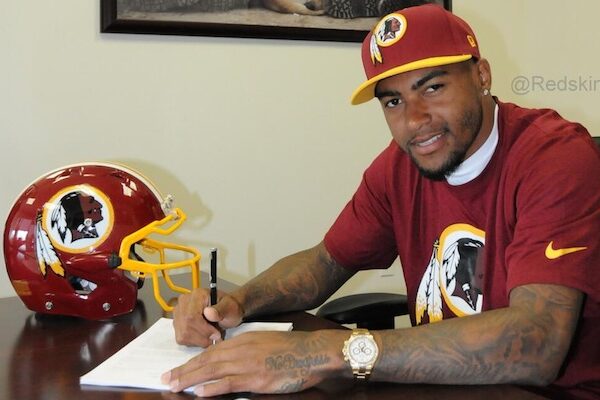
The Philadelphia Eagles have a history of treating their players poorly. Perhaps their lack of championships is karma, which, as a fan, I’m allowed to say. From Cris Carter to Reggie White to Brian Dawkins, the organization has let players walk away before they should have and under questionable circumstances. But the conditions surrounding DeSean Jackson’s departure might be the worst yet. That’s why I don’t blame him for signing with the Washington Redskins, a division rival. He gets to play with a quarterback that loves to throw the long ball in RGlll, a good possession receiver in Pierre Garcon and a rising young running back in Alfred Morris. He also gets to play the Eagles twice a year.
I’ve accepted that DeSean Jackson is gone, but it’s never going to sit right with me. For six thrilling seasons, I loved seeing #10 split wide for the Eagles. I love watching him streak down the sidelines en route to the end zone, and I loved how he came up big in divisional games. More than anything, I thought he would be a cornerstone of a new era in Philadelphia, part of a core group that would erase the memories of past failures. That’s not going to happen, so now I just want to see him succeed. DeSean Jackson and I are basically the same age, so when I look at him, I see a peer. Hell, I see myself. That’s exactly why I hope he proves people wrong in D.C.—especially the Eagles.
Julian Kimble was too skinny for organized football, but he was a street football Randy Moss as a kid. He tweets at @JRK316.